
RBA Bakery Tour: How to succeed in a bagel bakery
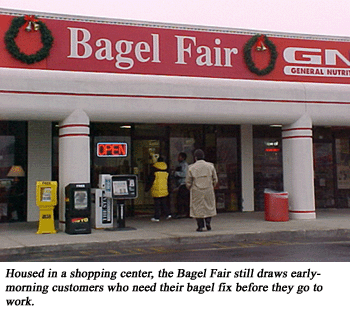
The Bagel Fair has succeeded for 26 years as a true New York-style ‘bagelry' by sticking to traditional methods, varieties and old-fashioned great service. You can visit this store on the March 27 retail Bakery Tour during RBA Marketplace 2001.
By Carol Meres Kroskey, baker-editor
Contents
East meets Midwest
That's no lye
Kosher rules
Independent retail perspective
…and lots of service
For more information
Products come and products go, but a true classic endures. At least, that's what seems to apply to The Bagel Fair in Indianapolis. After witnessing the rise and fall of numerous chain bagel shops, owner/manager Reyna Pauker credits the shop's 26 years in business to quality bagels made with traditional ingredients and methods, and served with courtesy at a fair price.
The Bagel Fair is located in a shopping center that requires people to make it a destination stop, yet a steady stream of customers arrives throughout the day to enjoy one of 13 different boiled, hearth-baked bagels. Reyna uses the same formulas her father and uncle brought with them from New Jersey when they opened the shop in 1975.
East meets Midwest
In fact, says Reyna, New York bagel bakers would feel perfectly at home in her shop, where the equipment and production processes follow the same age-old methods they employ back home. "Of course, if there's a better way to do something, we've kept up with it," she says. "Members of my family have been in the bagel business for more than 65 years on the East Coast, so we've kept up with updates over the years."
For example, the doughs are mixed in a heavy-duty spiral mixer, while bagel-forming equipment has taken the place of the labor-intensive handwork needed at one time. A walk-in retarder ensures controlled fermentation, while providing a cushion of additional prepared dough pieces that can be quickly prepared if customer demand is especially high.
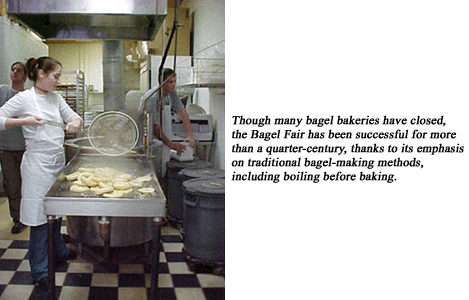
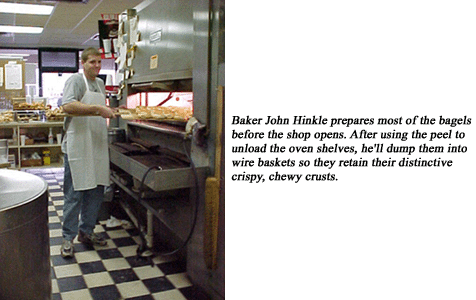
On the other hand, the bagels still are boiled to partially cook them and provide the traditional glazed finish and chewy texture that characterizes New York-style bagels. After boiling, the bagels are arranged on burlap-lined redwood boards, then placed in a revolving-tray oven to bake before being flipped directly onto the hearth of each shelf. The bakers remove them with wooden peels and dump them directly into wire baskets for display.

That's no lye
Reyna is a fount of knowledge about bagel-baking, including the fact that they once were boiled in water that contained a bit of lye. "That was before the health department decided a lye solution didn't belong in a bakery," she says. She also notes that there really is a difference between bagels made in New York and those made in other parts of the nation. "New York's water is soft," she points out. "We did have to change our formulas to accommodate the fact that Indiana has hard water." In addition, she notes, sugar doesn't really belong in bagel dough; instead, the dough's yeast food comes from malt syrup. And, she says, perforated pans and rack ovens just don't provide the same type of baking profile as burlap-lined boards and oven hearths.
"I can teach anyone to make bagels in 10 minutes," Reyna says, "but it takes years of experience to understand how to work with the doughs so you get consistent quality when the bagels come out of the oven."
Because Reyna formulates the doughs and helps the bakers scale the ingredients, she provides the quality control that guarantees the bagels maintain their authentic taste and appearance. "Occasionally, the dough mixers wanted to get too creative," she says. "So I scale the flavoring ingredients that they add to the rest of the dough ingredients. It's not that I'm hiding any secrets--I provide the consistency instead."
While that might seem demanding, in fact, the doughs only have to be mixed and made up about three times a week. "Traditional New York bagels need at least 24 hours in the retarder to firm up after proofing," Reyna explains, "or they'll be too soft to hold their shape when they're boiled." In addition, she notes, the formed proofed bagel-dough rings can be retarded up to 48 hours before they no longer make a good bagel. As a result, the retarder can hold extra made-up bagels that can be boiled and baked to fill in bins that are running low on products.
Because the bagels do continue to ferment in the retarder--though much more slowly--the bakers have to judge whether or not they need some additional fermentation before they're deposited into the kettle. "If the bagels are fairly large and airy," Reyna says, "they take less time to boil because they cook faster. But if they're too small, we cover them and let them rise before boiling them."
Kosher rules
The Bagel Fair's products are certified kosher, which means that varieties such as chocolate chip or jalapeno cheese can't be offered. For folks who want flavors beyond the traditional plain, onion, garlic, sesame seed or poppyseed bagels, the shop does carry some sweet varieties, including blueberry, cinnamon raisin and cinnamon apple. Reyna likes to work on seasonal formulas, such as the pumpkin bagels she offered last fall.
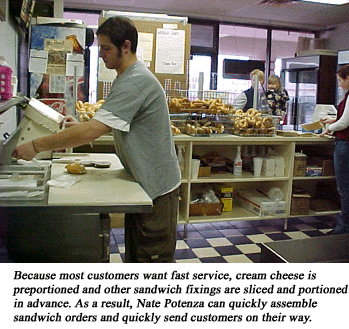
The shop also offers a variety of spreads, which the employees prepare on the premises. "We want to offer the best quality we can find," Reyna says, "so we use fresh vegetables and fruits when we make our spreads. In fact, we buy them at retail so we can pick out the freshest produce that day." The vegetables are chopped up in a food processor, then mixed with cream cheese and packed in containers. "We don't sell individual servings of spreads," Reyna says, "but if someone buys a bagel with a spread and prefers to add the spread himself, we provide the individual container.
"Because we make sandwiches that have meat or cheese on them, we can't guarantee our customers that any of the bagels we cut with our knives are still kosher. So, our observant customers can still enjoy our fresh bagel with a cream cheese spread if they take the bagel home or to the office and use their own knives," Reyna adds. Customers also can purchase 8-oz. containers of the spreads.
Independent retail perspective
The Bagel Fair differs from chain bagel stores because it reflects Reyna's unique stamp. For example, she says, her baker's dozen is really 12 bagels. However, customers get that 12th bagel free, paying only for 11 bagels. "I believe in saying what you mean," she says. "If a customer just wants 12 bagels, she gets 12 bagels, but that 12th one is the bonus. I know it makes me different, but I think customers enjoy that."
Reyna also has definite ideas about wholesaling. "I discourage wholesale customers, though I don't completely avoid it," she says. "Wholesale customers get a slight discount, but we don't slice the bagels or deliver them. And, I'm strict about a couple of things--no one gets a better deal than anyone else, and no one sells for less than I do.
"I don't think the little guy should pay more than a customer who buys a lot. I set a fair price, and charge everyone the same amount. And, I don't believe in being undercut by my own customers. I don't mind if they charge more than I do, but I don't sell to anyone who would undersell us."
…and lots of service
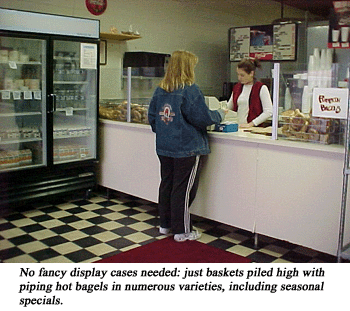
Reyna also has definite requirements for her employees. "A service philosophy is number one," she says. "If my employees have that, they know I'll be behind them 100%. But rudeness to a customer is cause for immediate dismissal. So, it's important to hire the right people. When it comes to high school kids, don't be put off by appearances, but do go with your gut feeling. I'm most concerned with how our employees treat our customers, and how well they learn what I need them to learn. To help them, I prefer to let them know when they're doing something right. I've always enjoyed watching kids blossom when they begin to understand that they're good at what they do."
Friendly, efficient service, delicious authentic bagels, a fair price--it's a simple formula for success, but as The Bagel Fair has proven, it's a formula that stands the test of time, and the fires of competition.

For more information on RBA Marketplace 2001…
• Click here for an overview article about Marketplace 2001.
• Bakery Online will cover the event, including all RBA bakery tours. This coverage will appear before and during the event in a special "RBA Marketplace 2001" section of our News and Analysis homepage. (See link at left-hand side of this page).
• After the event, just search "RBA Marketplace" or your own favorite keywords on the site to find these stories in our permanent Editorial Archive.
• Send e-mail to RBA at attend@rbanet.com; telephone (800) 638-0924 or (301) 725-2149; or click to visit RBA's website.
Carol Meres Kroskey is the award-winning former senior baker editor of Bakery Production and Marketing magazine. She's held baking and pastry cook positions at various retail, hotel and supermarket bakeries, and spent several years as an experimental baking technician for the carol.kroskey@prodigy.net