
RBA Bakery Tour: Family keeps in tune with the times
Long's Bakery combines modern technology with time-tested formulas and makeup techniques to better serve a half-million customers each year. You can visit this store on the March 27 retail Bakery Tour during RBA Marketplace 2001.
By Carol Meres Kroskey, baker-editor
Contents
One big, extended family
Appearances can be deceiving
Technology aids production consistency
Even the air is high-tech
Hand-cut and yeast-raised
For more information
When it comes to hot, fresh glazed donuts, Indianapolis' favorite spot is Long's Bakery. Long's has been at its current location since 1955, making it one of the select group of long-term survivors of the ups and downs of the past half century.
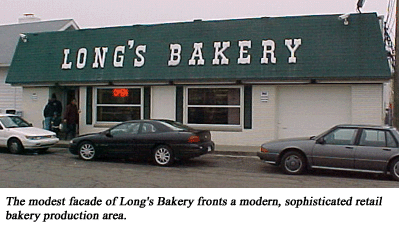
The bakery has an unusual configuration, however. Carl Long built it behind a house, which became his family's home. Although he had intended to eventually replace the house with a parking lot for the bakery, his wife Mildred still lives there. Long's Bakery currently operates two locations, each of which have production facilities for a full range of products made from scratch.
One big, extended family
The current owners are the Longs' son Mike Long, daughter Carole Reinhart, and Carole's husband Mike Reinhart. Mike Long's wife, Luanne, works with them in the business. The Rineharts' two sons, daughter and daughter's husband also work in the business as does the Reinhart's grandson and nephew. As a result, Long's Bakery really lives the spirit of a family business.
The employees form an extended family as well, because many bring in relatives to work in the bakery. The Rineharts and Longs encourage this with a bonus policy that rewards the employees who bring in a friend or family member who stays on the job at least 6 months. It's a particular challenge because the bakery is open from 6 a.m. to 11 p.m. every day.
But while the bonus encourages folks to bring in their friends, the efficient work environment encourages them to stay. The original location, which occupies about 3,200 sq. ft., is set up to maintain a comfortable atmosphere, is equipped with labor-saving equipment, and is organized for a fast-paced workflow that enables the bakers to provide plenty of product for the half-million customers it serves annually.
Appearances can be deceiving
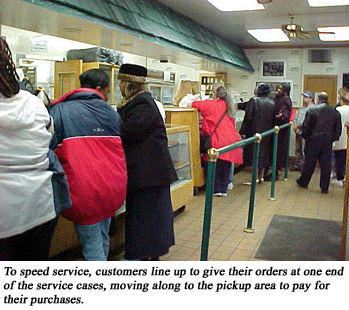
Actually, the bakery's appearance is somewhat deceptive, as the relatively small store fronts a roomy production area. The retail store features high-volume showcases that house cakes, cookies, pastries and most varieties of donuts. Customers channel in front of the showcases, then past the cash registers. Because of tight quarters in the retail area, the bakery's most popular product--yeast-raised donuts--isn't displayed in the store. Instead, they're visible through the door that leads to the production area.
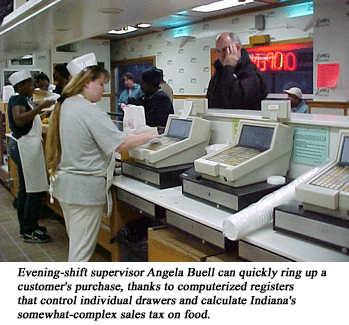
Cold beverages are kept in a retarder behind the counter, but customers who want coffee serve themselves at a coffee station after they've checked out. To keep things simple, the employees provide a 12-oz. foam cup and a lid to these customers at the cash register, which allows them to fix coffee to their liking without holding up service for other shoppers. Computerized registers set with price lookups automatically figure out if tax should be applied, and what percentage. The store employees each have their own drawer, making it a little easier to balance their cash at the end of their busy shifts.
Technology aids production consistency
Part of the attraction of Long's Bakery is a product line that still uses the same scratch formulas that Carl and Mildred introduced to their customers. But the bakers have modern-day help that keeps the workload from becoming overwhelming. For example, digital scales take out some of the variability in producing the scratch formulas consistently. Helping out consistency is the fact that the bakers use filtered water that also is tempered to come out of the faucet at 74°F every time.
Says Carole and Mike's son Dennis, "Water that has to be treated with chemicals can change from season to season. For example, in the fall, when autumn leaves make water sources more turbid, the municipal water treatment plants tend to use more chemicals. That means the water varies from season to season, and that can affect how our doughs and batters come out. So, we installed a filter that eliminates most of the minerals and chemicals. Conditioning the water to a constant temperature and eliminating the seasonal variability in pH and minerals means that our bakers don't have to make adjustments to our formulas."
Even the air is high-tech
Dennis points out that the bakery is heated or air-conditioned so the room temperature is constant too. By helping to keep the flour, sugar and shortening ingredients at room temperature, additional formula adjustments become unnecessary. Currently, he's working on a project to make sure the relative humidity inside the bakery can be controlled to eliminate that as a variable that requires seasonal adjustments.
"I want to make sure that we can make the same products my grandfather did," Dennis adds, "but I also want to make it easy for our employees to learn to do that quickly by taking a lot of the need for adjustments out of the system. So, instead of doing all the calculations to figure out whether they need ice in a dough, they can concentrate on scaling accurately, mixing consistently and baking correctly to yield quality products every time."
Although heating, air-conditioning and humidification do require some additional energy outlays, Dennis notes that utility bills aren't necessarily higher as a result. "We set our systems so the bakery has positive air pressure," he explains. "So, when a customer comes in during the winter, cold outside air doesn't come in with him. Instead, some of the bakery air flows out. However, our heating system doesn't have to kick in to warm up any cold air that would have come into the bakery. The same thing is true in the summer. Our air-conditioning system doesn't have to cope with surges of hot air. Instead, our systems run at a pretty steady pace, keeping the bakery air at a preset temperature, and maintaining a controlled atmosphere for the products. Another benefit of positive air pressure is that insects can't get into the bakery as easily."
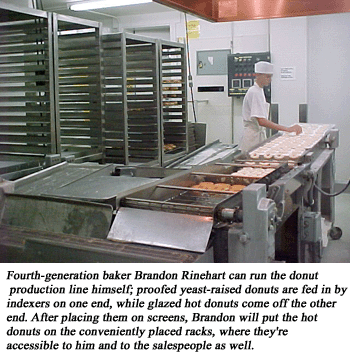
Production is an interesting mix of handwork and mechanized processes. For example, automated depositors ensure that product scaling is fast, accurate and consistent. A rack oven turns out batches of cakes, breads, Danish and other pastries quickly. A conveyorized fryer system turns out perfectly fried donuts to fill the racks quickly--important because 75% of the bakery's sales are generated by donuts.
Hand-cut and yeast-raised
The most popular variety is the yeast-raised donut. That's where the handwork comes in. All of the yeast-raised donuts are hand-cut, despite the fact that the donut dough is sheeted out on conveyors. "Our bakers can cut the donuts faster than a machine," says Carole. "We're famous for our hot donuts, so the bakers have to work fast to keep up with demand. We haven't found a machine that can do the cutting any faster than they can.
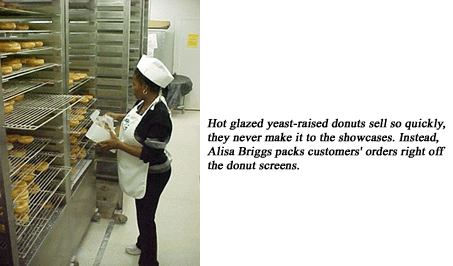
"We fill a lot of large orders, and not all of them are phoned in ahead of time. In fact, we don't even put the yeast-raised donuts into the bakery showcases. Instead, the bakers just put the hot glazed donuts on a 'wall' of racks, and the sales employees come into the back to box up the donuts for customers." To help the employees serve customers quickly, the Rineharts buy automatic boxes that don't need to be assembled, just folded out and filled.
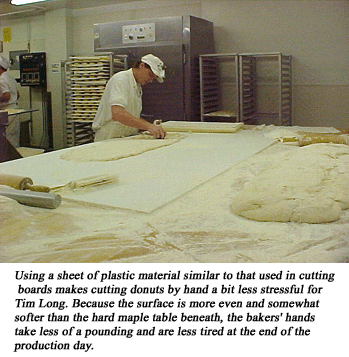
Dennis reveals one innovation that he credits for speeding up hand cutting. The bakers cover the wooden workbench with 8 ft. by 4 ft. sheets of 1-in.-thick, high-molecular-weight plastic, a material similar to that used to make plastic cutting boards. "I like using the plastic because it requires a lot less dusting flour than we need to use with a wooden surface," he says. "The sheets provide a more level cutting surface than the wood, which gets worn and uneven after a while. That's important when you're cutting products by hand, because you want the cutter to go through the dough completely so the holes and edges release cleanly. If you save a couple of seconds after cutting each product, that time adds up quickly when each baker cuts an average of 60 dozen donuts an hour."
The cake decorators use the same blend of hand skills and automated assistance to fill numerous orders for special-occasion cakes. Customers can choose piped-on flowers and decorations, airbrushed stencil designs, drawings added with the aid of image projectors, or exact photo reproductions prepared on a computerized cake decorating system.
Of course, with a 17-hour sales day, the employees have to clean as they go to maintain order in the store and production area. To make that easier, Dennis notes, all the equipment in the bakery is mobile. After all, a family bakery is a good thing, but time away from the bakery is important too, and the faster clean-up proceeds, the more time for family fun there is.

For more information on RBA Marketplace 2001…
• Click here for an overview article about Marketplace 2001.
• Bakery Online will cover the event, including all RBA bakery tours. This coverage will appear before and during the event in a special "RBA Marketplace 2001" section of our News and Analysis homepage. (See link at left-hand side of this page).
• After the event, just search "RBA Marketplace" or your own favorite keywords on the site to find these stories in our permanent Editorial Archive.
• Send e-mail to RBA at attend@rbanet.com; telephone (800) 638-0924 or (301) 725-2149; or click to visit RBA's website.
Carol Meres Kroskey is the award-winning former senior baker editor of Bakery Production and Marketing magazine. She's held baking and pastry chef positions at various retail, hotel and supermarket bakeries, and spent several years as an experimental baking technician for the American Institute of Baking and as a test baker at The Long Co., a co-op for independent wholesale bakers. Carol can be reached at carol.kroskey@prodigy.net