
Pie Safe: First-Case Implementation of Standard 75
By Bob Sperber
Table of Contents
Retailers, Sharpen Your Ordering Pencils
Challenge testing and Auditing
Implementation Steps
Benefits Derived
Implications Beyond Dairy
The grocer wants to sell a lot of pie, and places it out on a table with a great promotional sign. Will the product keep?
That's the question retailers and the U.S. Food and Drug Administration (FDA) want to answer, and one that fell squarely on the shoulders of Specialty Bakers Inc., based in Marysville, PA.
The company saw an opportunity to assure safety for its fresh pies by certifying those produced at its Lititz, PA plant to Standard 75, a system of testing and certification intended to provide safety assurances for products that are shipped, stored and retailed at ambient temperatures. The standard, in draft form, is being advanced by NSF International, whose focus is on developing standards, product certification, registration services and educational services in environmental and public health safety.
Specialty Bakers appears to be the first company certified to the nascent standard, which is currently in draft standard mode. Three months after the draft's publication, the bakery was awarded a Certification for Non-Potentially-Hazard Foods. (See related article).
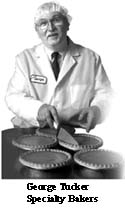
"The purpose certifying the shelf-stability of our pies is to provide a marketing tool for our customers…a way for them to generate impulse purchases and know the product will hold up," George Tucker, quality assurance manager for Specialty Bakers told Bakery Online.
The result of the testing and certification effort, described below, is that the company can now claim—with arguably more certainty than any other wholesale baker in the industry—that its fresh pies have six days of freshness from the date of manufacture. The company can also claim six days of ambient display freshness and safety for its thaw & sell and its bake & sell lines, from thaw or bake date, respectively.
Retailers, Sharpen Your Ordering Pencils
The first products to bear the certification are pumpkin and sweet potato pie. These products will bear the NSF Mark logo on product packaging. Retailers concerned with room-temperature displays on high-moisture pies can test the waters with the Specialty's certified specialties.
Multiple sizes of both of Specialty's brands, Country Baker and Oehme Pie (pronounced like the name "Amy") were certified to the draft standard.
The Country Baker products include Bake and Sell Pumpkin Pie, and Sweet Potato Pie; Fresh Pumpkin Pie and Sweet Potato Pie; and Thaw and Sell Pumpkin Pie and Sweet Potato Pie.
Oehme Pie products certified include: Bake and Sell Pumpkin Pie and Sweet Potato Pie; Fresh Pumpkin Pie and Sweet Potato Pie; and Thaw and Sell Pumpkin Pie and Sweet Potato Pie.
Challenge Testing and Auditing
"Because we use eggs, dairy and other ingredients, the heath regulators require that the product is either refrigerated, or meets FDA's requirements," said Tucker. Certification to Standard 75 provides a mechanism for laboratory evidence, in accordance with the FDA Food Code, that a product is not a potentially hazardous food.
The product may require reformulation in order to balance moisture, pH, ingredients and preservatives before proving itself to be free of potential hazards. In Specialty's case, pH and water activity were lowered and preservatives were adjusted.
Tucker explained that "essentially, the standard is a marriage between the marketers who want to sell fresh products and the foods regulators who want to make sure it's safe."
The cost of certification will vary, depending on factors such as the product's water activity, the need to reformulate and management factors. NSF is optimistic, reporting that one manufacturer estimated that if it implemented the standard, costs would be less than a penny a pie.
The actual auditing and certification process has a cost, too, in effort. Tucker said this "is not he easiest thing to do." Undergoing certification, much like a quality management standard (e.g., ISO 9000), requires on-site verification by a third-party auditor.
Toward that end, NSF conducted testing and auditing was provided through a partnership with Silliker Laboratories Group, Homewood, IL, which did the challenge, or microbial, testing. (See related article).
Implementation Steps
The standard procedure for becoming certified begins with an Application for initial NSF Certification. This is followed by product testing, which entails specific tests that include measuring pH, water activity, and if required, inoculating specific strains of bacteria to determine the product's inability to support rapid and progressive growth of the pathogens.
Next comes the initial plant audit, followed by annual update audits. The purpose is to assure that only authorized ingredients are used in the products; quality assurance and quality control procedures are followed in the manufacturing process; and that all requirements of the standard are met.
Assuming all prerequisite criteria are met, certification follows. A signed contract and an Official Listing is generated. This entitles products to display the NSF Mark on the product label and in various listings.
Benefits Derived
In return for the effort his company has undergone, Tucker said that the certification fulfills a role that provides benefits to his company's customers' marketing efforts—and therefore, benefits to Specialty in serving those customers.
According to Tucker, "In this competitive baking industry, manufacturers have been challenged by grocers to provide safe, shelf-stable products. NSF Standard 75 brings clarity to the marketplace with uniform standards by which all products can be measured. I used to provide retailers with at least ten pages of documentation to satisfy state and local health inspectors. Now, with the NSF Mark on my products, retailers can confidently display them without refrigeration."
From NSF's point of view, Kathleen Pompliano, business development manager, said, "Shelf-stability and food safety issues are top-of-mind for baking manufacturers and retailers today." She defines the initiative as a program that "provides a mechanism to assure the safety of these products when stored at ambient temperatures."

According to Pompliano, key elements of the NSF certification process include:
- The NSF Mark enjoys worldwide recognition and trust among public health officials.
- The NSF Mark assures manufacturers, retailers, regulators, and consumers that the products have been tested and are safe to store at room temperature.
- Retailers can display products certified to NSF Standard 75 at room temperature, freeing up valuable refrigeration space.
- Certification reduces the need for multiple testing for different states.
Certified customers may use the NSF Mark as a marketing tool to increase your opportunities for growth.
Implications Beyond Bakery
According to Pompliano, the standard "benefits the dairy industry as well as the bakery industry" because of the dairy-based icings and fillings used by bakers. She reports that NSF has "already had several requests" from suppliers in this sector. "It shows that they've take additional steps to ensure the safety of the products they supply to bakeries. It shows that they ‘re trying to be more competitive."
The NSF Mark may be applied to the product packaging as well as outer packaging, or may be accompanied by a letter of supplier certification. How the certified company uses the certification is largely a marketing and customer service decision.
Standard 75 includes four main categories: breads or pastries containing vegetables or soft cheeses added prior to baking; bakery products filled or topped with crème, custard or cheese after baking; products that are filled prior to baking; and components such as toppings, glazes, icings; and fillings stored without temperature control prior to being used in other products.
It is likely that if the standard gains momentum, its implementation could expand to sectors outside bakery wholesale manufacturing to other ingredients and products likely to be displayed at ambient temperatures at the retail level.
The standard was developed after NSF's Conference for Food Protection meeting in 1996, when attendees recommended that FDA work with a third party organization to develop a standard. Currently, the draft standard is being reviewed by the National Advisory Committee for Microbiological Criteria for Foods (NACMCF) at FDA's request.
With regard to the draft's government acceptance, Andrea Jensen, NSF's senior director of standards, has said, "When the standard becomes available, we are confident that any frustration and confusion experienced by manufacturers, regulators and retailers will be eliminated" and that "public health—our main concern—will be better protected."
NSF is a not-for-profit food safety and consulting organization serving, in this case and others as a de facto standards-making body. The organization has earned a reportedly unique designation as a Collaborating Centre by the World Health Organization for both Food Safety and Drinking Water Safety and Treatment. NSF is based in Ann Arbor, MI with additional offices and laboratories in Sacramento, CA; Washington D.C.; Brussels, Belgium; Cairo, Egypt; and Sydney, Australia.
For more information on Standard 75 or <%=company%>, visit www.nsf.org, email Kathy Pompliano at pompliano@nsf.org or telephone 800-NSF-MARK.
For more information on Specialty Bakers Inc. or its products, send e-mail to productinfo@specialtybakers.com or telephone 800-755-9890.