
Automation of grain mills
To automate its grain mills, Italian supplier Ocrim turned to a control and software supplier whose mantra is: Totally Integrated Automation. Ocrim now believes its large, turn-key mills, together with material handling and transportation systems, can be more easily upgraded and expanded…
Contents
Standardizing its systems
PC-based automation bridges the PLC gap
Automation flexibility
Maintenance and business benefits
For more information
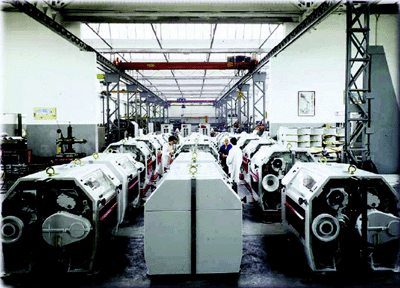
Ocrim, located in the North Italian city of Cremona, is a household name to millers all over the world. Not only are the company’s highly innovative grain mills built in Cremona, but millers from all over the world come here to learn how grain is turned into flour in this day and age. Today's systems consist of machines with mating rolls and sifters. These are intelligent systems in which degree of fineness, purity, moisture content and storage are precisely monitored.
Ocrim believes that due to its recent automation improvements, the term “grain mill” no longer does justice to the systems it offers. Indeed, the product line ranges from dock loading systems over mills for different kinds of flour to storage silos and systems for transporting the most widely varied final products.
Standardizing its systems
The integrated system consists of a series of special machines. Ocrim combines these into large turnkey systems, but also supports the customized modernization of existing systems, as grain mills innovations are often gradual or are expanded through the addition of upstream and downstream machines. Ocrim ensures its technological edge through the use of extraordinarily innovative, reliable and safe machines.
In order to be able to make up customer-specific solutions from individual components quickly and economically, the decision was made to use generally applicable automation standards—and standardize on the offerings of a single major automation vendor, Siemens Energy & Automation Inc. , with North American headquarters are in New Jersey and operations in Alpharetta, GA, USA.
In short, standardization reduces the overhead in terms of cost, effort and time, across the lifececycle of the installed system.
PC-based automation bridges the PLC gap
Standard tools provide a kind of flexibility, as well, and this is seen in the details that constitute the automation of Ocrim’s equipment.
Traditionally, electrical and mechanical industrial equipment has been automated with programmable logic controllers (PLCs), which replaced electrical relays and added many more features due to the ability to network and interface with computers. Today, this technology is still the mainstream. For instance, PLC-based controllers are usually installed locally to oversee various equipment subsystems, are networked together with other PLCs and are managed by one or more higher-level controllers and visualization systems. From these higher-level PLCs, software systems—nowadays, typically based on PC and Micrisoft Windows technology—are used to provide operator interface, data acquisition and additional supervisory control functions.
Additionally, for the past few years, there has been a move toward using standard computer technology to perform some or all of the tasks that used to be performed by PLCs. The reason for this is simple: The cost of computer hardware has fallen so low that it is often possible to perform all machine and process control in this manner. However, there are still real-time high-speed applications requiring fast, reliable response times that cannot always be trusted to control logic programs hosted 100% in a PC-only system.
And so Ocrim chose to pick and choose a mix of components from Siemens’ Simatic line. Controllers include both programmable controllers and PC-based controls solutions including the PC-based WinAC system, which provides computing and communication functionality and also executes on a PC some real-time control functions that would otherwise be used for operator control and process visualization.
For visualization tasks, Ocrim uses Siemen’s WinCC software system for operator (a.k.a. human-machine) interface, data acquisition and supervisory-level control.
A single underlying operating philosophy, which Siemens calls Totally Integrated Automation, applies to all controllers, the operator interfaces, programming tools and information technology infrastructure: simply put, all components are fully compatible and share a common database. This simplifies communication from the lowest level of instrumentation and control, up through the networking, computers and software screens used by engineers, maintenance and operations personnel who, after all, all have various reasons to require access to the electronic backbone of Ocrim’s turnkey systems.
Automation flexibility
Two examples illustrate the flexibility, or alternative automation strategies, that can be chosen for different kinds of equipment and process systems. In smaller systems, WinAC handles all automation tasks centrally, taking care of any data processing tasks that arise at the same time. An example of this model is a grain mill in Algeria. The plant there is divided into three sections. Each is automated by an industrial PC which, together with WinCC, also handles centralized operator control and process monitoring. The three PCs exchange global data using the same standard tools and can coordinate their activities autonomously (according to the rules programmed into the control system and using a tool Siemens calls MPI.) A fourth PC is linked via Ethernet that establishes the connection to the company's main control center with an integrated modem.
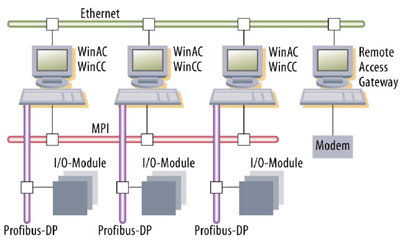
Another example comes from one of the newest grain mills Ocrim installed, in Italy. Here, a system automated with Simatic PLCs (Model S7-300) was expanded to become what is now a good representative of a typical "mid-range" system configuration. It consists of a complex automation structure whose components are linked to one another via Ethernet, Profibus, MPI and AS-Interface (a networking or “bus” protocol for connecting simple switches and sensors). The individual machines are automated by a total of 74 distributed controllers. (Of these, 53 are Simatic C7s). Several of these are equipped for weighing (using what are called Siwarex U modules). The pneumatic components are integrated in bus communication via AS-Interface. For centralized automation tasks, Ocrim used PC-based automation for plant sections in which all control tasks are handled on a distributed basis by PLCs along with both the WinAC real-time control software and the higher-level WinCC operator and supervisory software where needed. As expected, the data from all local controls and stations are collected on one supervisory PC station, from which the programs can be accessed from the company's main control center.

Maintenance and business benefits
The connection to the main control center, however, is not just for the purpose of remote maintenance. According to Ocrim’s Alberto Caporali, "We provide PCs on which WinAC and/or WinCC is installed and have the option of configuring and programming identical systems here in the office.
“The customer receives pre-tested programs, that are executable via modem. That saves time and travelling expenses. But above all, we can considerably increase customer satisfaction, since a good part of the commissioning tasks are taken care of on our premises, not on the customer's. As we see it, this is yet another enormous advantage of PC-based automation, and one of the reasons that we have made this the standard solution for our systems."
For more information…
Bakery Online includes Siemens Energy & Automation Inc. in its Buyers Guide.
For MUCH more information, visit these links on our sister site, Food Online:
Siemens’ Storefront, or the Siemens Pavilion , which provides far more detail on the company’s solutions for food processing and packaging, including full descriptions of solutions ranging from instrumentation and control through enterrpise and supply chain management.
Edited by Bob Sperber ,
Managing Editor, Bakery Online