
Cook good, serve generously, price modestly—people will come!
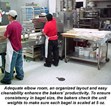
Since 1905, Shapiro's Bakery and Deli has operated according to this motto. The downtown Indianapolis fixture deserves its reputation for generous amounts of good food at fair prices—especially its bakery products.
By Carol Meres Kroskey, baker-editor
Contents
'Real bagels' can be steamed
It's hard not to eat dessert first
Keeping sanitation paramount
It's not every baker who gets to design his own production facility. Luckily for bakery manager John Poulsen, that's exactly what he was able to do for Shapiro's Bakery and Deli, located in downtown Indianapolis. Owner Brian Shapiro let John, a classically trained baker from Denmark, have a free hand to make the bakery department as productive as possible.
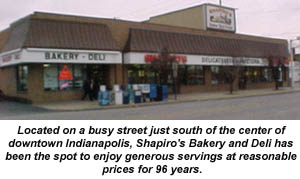
The need for productivity is understandable, considering the deli serves thousands of customers each week at both its sit-down cafeteria and in its carryout deli. A second location, opened in 1985, also gets deliveries from the bakery department. And a lot of the items on Shapiro's menu call for bakery products, especially its "real bagels". A neon sign in the deli's windows assures customers that's what they'll be getting when they buy bagels here. After all, what's a deli without a good bagel?
To make sure Shapiro's bagels met such rigorous standards, John went to New Jersey to train with "real bagel bakers" and returned with both the formulas and the methods that duplicate the East Coast's products.
Originally, the bakery shared facilities with the foodservice kitchen in the deli's main building. Although customers could watch the bakers at work, growing demand--thanks to Shapiro's continued business growth--required some rethinking of the production routine. As a result, in 1997, John was asked to convert a separate building behind the deli, originally used for storage, into an efficient, well-thought-out production facility. The careful planning that went into the bakery design is evident from beginning to end.
For example, the building's stock room has a separate air-conditioning system to keep the room at 60° to 62°F all year. John keeps it that cool so his ingredients can be mixed into doughs and batters without using ice in the summer, and without requiring other adjustments in the winter.
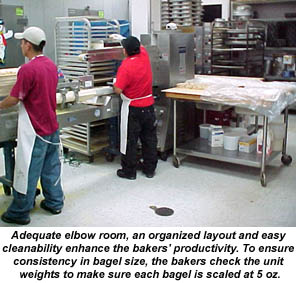
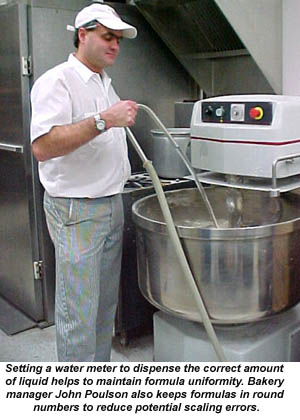
Because John and his helpers produce at least 1,500 to 2,000 bagels each day, the facility is designed to make bagel production more efficient. A spiral mixer, water meter and bagel makeup system enable the bakers to make a batch of about 500 bagels in just an hour. Different varieties of bagels are made fresh daily in large batches, then are frozen so the bakers can pull the wide assortment needed for each day from the inventory in the walk-in freezer.
John also made sure that the retarder was suitable for bagel production. "The cooler has a different condensing system to help the bagel dough stay moist," he explains. "The air has a higher moisture percentage. And the blowers are directed downward, not across the product, so the air circulation patterns don't dry out the doughs."
'Real bagels' can be steamed
While purists insist that bagels must be boiled, John points out the advantages of steaming them in rack ovens. "The steamed bagels have the same texture as boiled bagels," he says, "but they have an extended shelf life compared to boiled bagels. Customers can enjoy them a second day by slicing and toasting them. Baking bagels in a rack oven also cuts labor costs considerably because you can make about 450 bagels at a time by loading the oven once and unloading it once. That helps us to meet last-minute demands more efficiently."
John also notes that Shapiro's bagels are a generous size: they're scaled at 5 oz. So, steaming them in a rack oven allows them to expand to their full size, eliminating the chances that the crust will set prematurely and burst.
Because the bakers make the bagel doughs in large batches, they can make them in a large number of varieties as well. John likes to experiment with seasonal varieties, such as cranberry-walnut bagels. He also experiments with different shapes. His banana twist bagels incorporate rehydrated banana chips and nuts, but have a slightly different appearance because the bakers give the rings a half-twist before placing them on bagel boards to be frozen.
Besides their generous size, Shapiro's bagels are popular because of the copious amounts of extra ingredients used in the different varieties. "We don't skimp on the ingredients," John says. "Every bite should have some of the nuts or seeds or fruits in that variety. To distribute ingredients, such as nuts, more evenly, I like to grind them up somewhat in a food processor. Doing that makes sure they get mixed into the dough well. Also, the smaller pieces don't tear the dough during the last stages of mixing, and they don't interfere with the formation of a good skin on top of the bagel ring."
It's hard not to eat dessert first
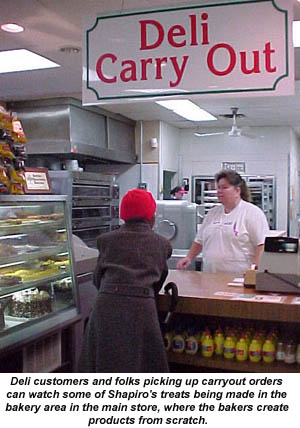
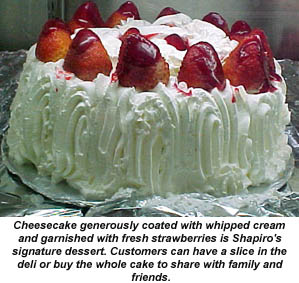
While the bulk of the production of bagels, breads, cakes and pastries is done in the production facility starting at 4 a.m., some baking still goes on in the main store, behind the deli counter, where customers can watch the bakers mix, bake and assemble some of the deli's delicious desserts. For example, the bakers mix carrot cake, harvest cake (carrot cake with the addition of coconut and pineapple), and cream cheese icing in the store's bakery. They also assemble and bake fruit and cream pies, and decorate some specialty desserts and pastries, including the deli's signature dessert, strawberry whipped cream cheesecake. Because the store's bakers start at 7 a.m. and continue working until about 3 p.m., customers who come to pick up bagels for breakfast or deli sandwiches at lunch can enjoy watching the bakery products coming out in a steady stream.
Because space in the front bakery is limited, John reformulated the batch sizes to take as much advantage of prepackaged ingredients as possible. For example, the bakers use 2-lb. bags of powdered sugar when mixing their cream-cheese icings, and they use preportioned bags of grated carrots for their cake batches. "Although usually the individual packages cost more than bulk items," John says, "we buy in such quantity that we get a price that's about the same. I try to build formulas in even numbers so they're easier to remember and easier to scale."
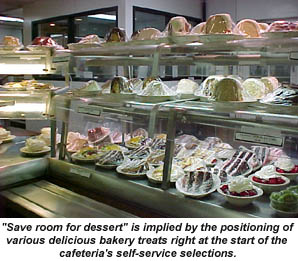
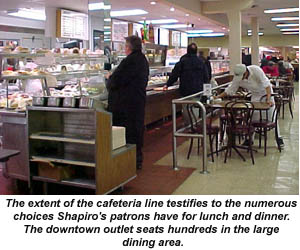
Watching the bakers at work surely builds an appetite, and customers who dine in the cafeteria certainly are reminded to save room for dessert. In fact, individual servings of cakes and pies are displayed right at the beginning of the cafeteria line, making it hard for customers to bypass something from the bakery. Besides generous slices of cheesecake, layer cakes and pies, customers can choose among hunks of four different kinds of bundt cake, including lemon and poppyseed.
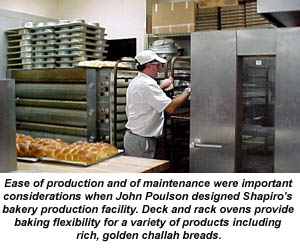
In both the deli's bakery area and the production facility, cakes are baked in deck ovens. John prefers the slow, even heat produced by deck ovens, and notes that the cakes don't dry out during baking because there's no air circulation to drive off moisture too quickly.
The deck ovens also yield other bakery treats, including an egg-rich challah bread made to John's own special formula. "I like to use brown sugar instead of regular white sugar," he says, "because it yields a more wholesome taste that's also different from competitor's products. For extra richness and shine, I egg-wash the breads before and after baking."
Keeping sanitation paramount
Because they make literally thousands of products each day, the bakers who work on bagel production wear protective food-grade gloves. John notes that it's a wise precaution to wear gloves when handling already-prepared foods after baking, but he also likes the additional protection they give to products while they're being processed.
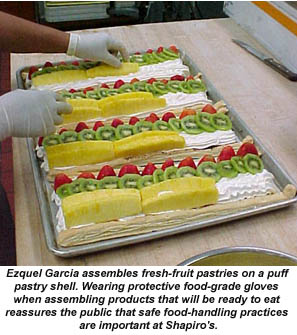
However, he stresses, gloves alone can't take the place of good sanitary practices, such as hand-washing each time a baker switches products or move on to another task. "When I designed the production area," he says, "I made sure we had hand sinks so we could be more conscientious about hand-washing. To be absolutely sure about sanitation, you have to follow the rules about exchanging used gloves for a fresh pair when you move to a different food item, and you have to wash your hands each time you exchange gloves. The foodservice industry is ahead of bakeries in this area, and there's plenty of information out there on the correct procedures to follow if you're using gloves in food processing."
Observing the bakers in the deli's production area wearing gloves reassures shoppers that customer safety is an unwritten, but important, part of Shapiro's motto too. Thanks to such attention to detail, Shapiro's will soon be celebrating its 100th anniversary—and people will keep on coming.
For more information on RBA Marketplace 2001…
• Click here for an overview article on Marketplace 2001.
• BakeryOnline will cover the event, including all RBA bakery tours. This coverage will appear before and during the convention, on our News and Analysis homepage. (See link at left-hand side of this page).
• After the event, just search "RBA Marketplace" or your own favorite keywords on the site to find these stories in our permanent Editorial Archive.
• Send e-mail to RBA at attend@rbanet.com; telephone (800) 638-0924 or (301) 725-2149; or click to visit RBA's website.
Carol Meres Kroskey, baker-editor at BakeryOnline, is the award-winning, former senior baker editor of Bakery Production and Marketing magazine. Her baking experience includes stints at various retail, hotel and supermarket bakeries as baker and pastry cook. She also spent several years as an experimental baking technician for the American Institute of Baking and as a test baker at The Long Co., a co-op for independent wholesale bakers. Carol can be reached at carol.kroskey@prodigy.net